The majority of canals across the UK were constructed between the 1760’s and 1830’s. However, detailed consideration of impacts regarding breach events of such structures within Flood Risk Assessments (FRA’s) is often overlooked, with fluvial and pluvial flood risk taking precedence. The canal breach event in Whitchurch in December 2025 highlights the risk associated with ageing infrastructure and the need for more comprehensive consideration within site-specific FRA’s.
What happened
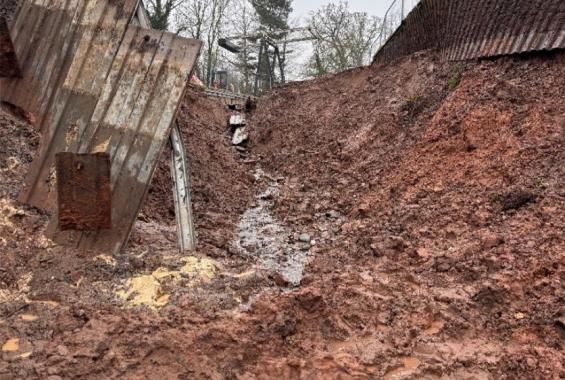
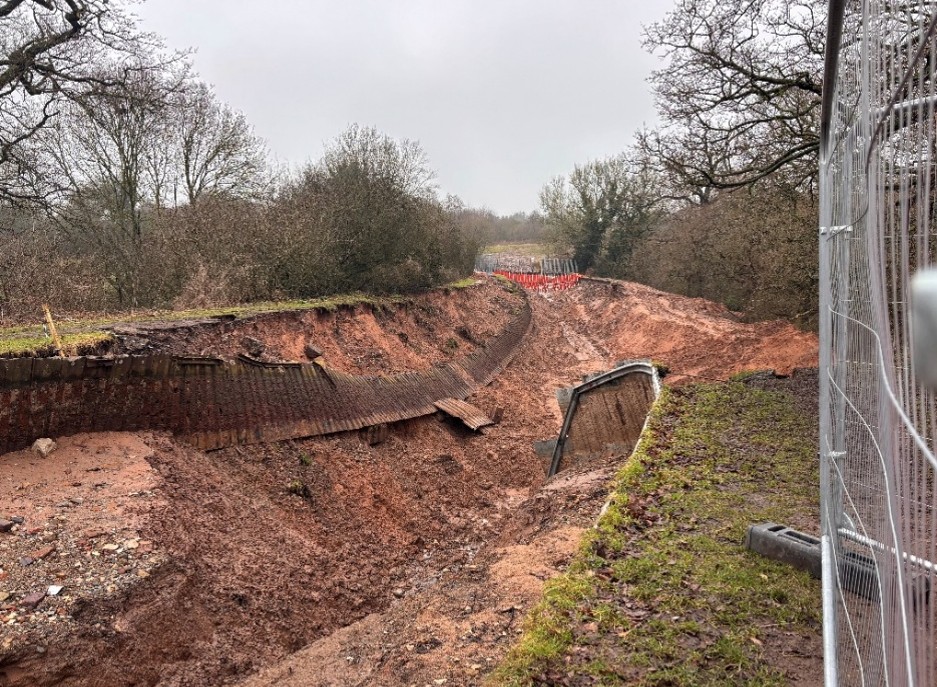
In December 2025, an embankment failure caused a section of the Llangollen Canal to collapse and drain into adjacent land and a nearby watercourse. The breach occurred near the New Mills Lift Bridge in Whitchurch and released approximately 12,500 cubic metres of water.
Two narrowboats were washed into the void during the event, with another left suspended over the edge. All three boats have since been successfully removed and refloated after careful efforts to reprofile the slope, allowing them to be lifted out whilst avoiding further damage. With the void cleared and the affected area dammed off, further steps can be taken to begin the full restoration of the canal.
Hafren Water visited the site in March 2026 to observe the breach site first hand and discuss the event with Canal and Rivers Trust personnel.
Causes and Impacts
The affected section of canal is around 200 years old. Embankments such as the one that failed were commonly constructed from locally won materials. The near surface geology at the site comprises sand and gravel deposits. Sustained egress from the canal to the embankment is considered to have led to its erosion. Over time, this is likely to have allowed finer sediments to wash out, eventually undermining the stability of the structure.
Consequences of the breach extend beyond the initial structural failure, with hydrological, economic and ecological impacts among the most notable.
The Llangollen Canal feeds the Hurleston reservoir, which in turn supplies drinking water to Nantwich and surrounding areas. The sudden loss of water caused significant instability in water levels downstream, requiring emergency damming of the canal and pumping in order to ensure protection of both the water supply and boaters navigating the waterways downstream.
Fish residing in the canal were washed out into the adjacent field, where they remained until infrastructure and plans for their removal were in place. After a significant volume of water was drained, low-voltage electrical currents were applied to temporarily immobilise the fish. A specialist team then collected the fish using aerated buckets before transferring them to an unaffected portion of the canal.
Ecologically, the canal breach may have had impacts not only for aquatic species but also for birds. Access to the site is required from the field to the west of the breach, where a row of trees line the embankment. A clear passage for machinery and materials was required, leaving Canal and Rivers trust with a deadline of March to ensure trees were cleared and potential impacts were minimised.
The breach has resulted in significant financial impacts with repairs estimated to cost several million pounds and take the majority of 2026 to complete. The navigation closure will continue to have an impact upon tourism and local business losses within the area until repairs are completed.
Impacts for FRAs
The breach at Whitchurch has highlighted several potential gaps within standard FRAs, specifically the consideration given to risk of canal flooding and the methods of assessing the ageing infrastructure.
Current FRAs acknowledge the presence of canals but often fall short of detailed assessments that account for the likely outcomes of a breach. An embankment failure is similar to a small-scale reservoir breach, in regard to the rapid release of water across new pathways. Environment Agency flood mapping does not model the possible outcomes of a canal breach in the same way that it does for reservoirs and fluvial systems, leaving the true residual risk less understood.
Increasing frequency of intense rainfall events can be an added stressor to canal embankments and increase the risk of seepage and embankment erosion. The incorporation of models based on future hydrological scenarios should be considered within assessments where vulnerable receptors are potentially at risk.
Assessing the potential flood pathways in FRAs can give a deeper understanding of the impacts of a breach event and allow for better adaptations / mitigation measures within developments.
Inspection of assets is undertaken by the C&RT on a Consequence of Failure (CF) and condition rating basis, with those of ‘High’ consequence (e.g., above a development) and of a lower condition rating inspected more regularly and allocated more funding to improve their condition.
If inspection records can be made available from the C&RT, FRAs for sites within the vicinity of raised canal embankments could/should analyse aspects such as the CF, asset condition and maintenance history to provide a clearer image of both breach likelihood and the severity of it impacts. Geotechnical information of embankments and surrounding ground could also be obtained to accurately assess the risk when combined with current and future hydrological scenarios.
Summary
The Llangollen Canal breach acts as a reminder that aged structures with no previously flagged issues can fail suddenly, with potential impacts not always fully assessed within current Flood Risk Assessments. Consideration should be given to whether hydrological modelling (depths and extents) of breach events would be beneficial to site-specific FRAs, particularly in areas where a raised canal embankment poses a significant risk. Pairing this with an analysis of the assets maintenance history, condition and CF ratings will strengthen how residual risk from canals is assessed and allow developments to be suitably designed.